
If you find yourself in Naples, you simply cannot skip the marvelous city of Pompeii. In 79 AD, the catastrophic eruption of Mount Vesuvius froze this Roman resort town in time, burying it under layers of ash. Today, it stands as one of the world’s most expressive windows into the ancient past. So come join me for a journey to the past!
What to see and do in Pompeii?
How to get there?
As I was staying in Naples, the easiest and cheapest way to reach pompeii is by train. Take the direct Circumvesuviana train from Napoli Garibalidi station (located downstairs from the main Napoli Centrale), to Pompei Scavi-Villa dei Misteri station. In just 36 minutes, you’ll arrive at the archaeological site to stroll through the ruins and explore the remains of the city which was once beating with life.
However, travel in Italy often comes with surprises. During my stay, there was a strike taking place which disrupted the trains and buses schedule. To ensure I didn’t miss my day at the ruins, I took a taxi from Napoli Centrale directly to the archaeological site. While more expensive than the train, it’s a reliable backup plan if you’re facing a similar situation.
For the return journey, I took the train back to Napoli Centrale from the Pompei Scavi station, which is conveniently located right across the street from the Porta Marina entrance.

Pro-tips for your visit
- Book you ticket in advance: To protect the site and manage overtourism, Pompeii now limits the number of visitors to 20,000 per day. I highly recommend booking your ticket online in advance.
- Check the “House of the Day”: The official website lists specific houses that are opened on a rotating basis to preserve them.
- Pack Light: Large bags aren’t allowed inside. Bring a small backpack and comfy walking shoes—those Roman cobblestones are uneven!
- Extend Your Trip: If you have more time, you can buy a 3-day ticket which allows for visits to the nearby villas of Stabia, Oplontis, and the museum at Boscoreale.
Entering the city
Upon arrival, simply scan your ticket at the entry point. Be sure to also grab a physical map as the site is massive, and you’ll definitely need it to navigate the nine regions!

Depending on how you arrive, you will likely use one of these two main entrances:
- Piazza Esedra: This is a convenient entry point if you arrive by taxi (like I did) or bus, as it’s often less crowded than the main gate.
- Porta Marina: The most common entry if you arrive by train at the Pompei Scavi station.
Navigating the ruins
The site is vast, divided into 9 regions. Each acts as a neighborhood frozen in time, containing a mix of villas, humble shops, and grand public squares.
The Theaters (Region VIII)
I began my journey from the second part of region 8 where the Grand Theatre & Small Theatre (Odeon) are still preserved. These were the cultural hubs of the city, where up to 5,000 citizens would gather for plays and musical performances.


Domestic Life (Region I)
This area offers a glimpse into Roman daily life. Don’t miss the House of the Lovers, famous for its preserved second-story balcony and the painting of two ducks.


Nearby is the Fullonica (Laundry) of Stephanus, where you can see how Romans cleaned their togas (the draped, dress-like garment worn by men in ancient Rome)—interestingly, they used aged urine as a cleaning agent!

The Spectacle (Region II)
Region 2 is home to the massive Amphitheatre. It could hold up to 20,000 spectators —nearly the entire population of the city— who gathered to watch gladiatorial combat.

The garden District (Regions III)
After that, I continued to region 3 which is largely unexcavated compared to others, but it is famous for its large open spaces and villas. Here you can find The House of Trebius Valens, known for its many “election posters” (graffiti) painted on the exterior walls, giving a glimpse into ancient Roman politics.

Commercial Hub & Central Baths (Regions IX)
Region 9 is the bustling “downtown” of Pompeii, located right off the main street Via dell’Abbondanza. The Central Baths were under construction when the volcano erupted. Because they were unfinished, they lack the marble decoration of older baths, but they show the massive scale and advanced heating technology of the time.
Here you will also find Snack Shops, Thermopolia, which are well-preserved “fast food” counters where Romans would buy hot stew or wine.

Houses (Regions V and VI)
Region 5 has The House of Orion which Features stunning, unique mosaics that were only recently uncovered. while region 6 contains some of the largest and most decorated mansions. House of the Faun is said to be the most famous house in Pompeii. It covers an entire city block and is where the famous “Alexander Mosaic” was found (the original is in the Naples Museum).
The Heart of the city (Regions VII & VIII)
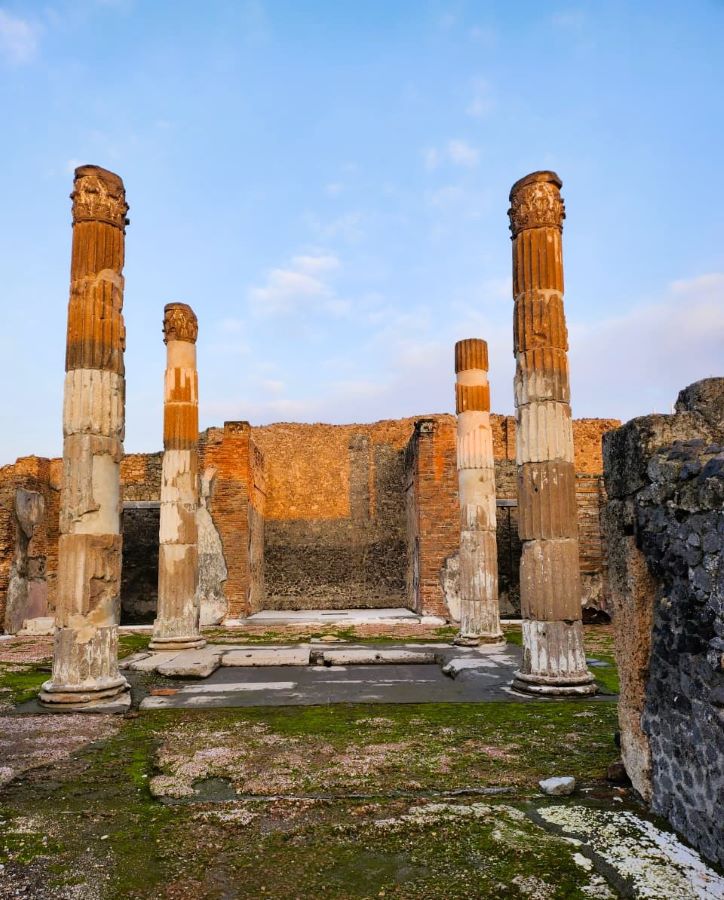
I ended my walk in region 7 famous for its forum, the center of political and religious life. I also checked the first part of region 8 where you’ll find the Basilica (the ancient law courts) and the ruins of the Temple of Jupiter, framed perfectly by the looming silhouette of Vesuvius in the distance.


Break and Lunch
For lunch, you can head to the restaurant located at Via dell’Abbondanza inside the archaeological site where you can enjoy a variety of products, such as salads, pizza and pasta along with drinks, take a rest and enjoy the views. It’s a perfect spot to refuel and rest your legs while soaking in the atmosphere of the ancient city.

Stepping back onto the train toward Naples, you’ll carry with you the weight of history and the awe of seeing a world frozen in time. Whether you come for the grand amphitheaters or the intimate details of ancient daily life, a day in Pompeii is an unforgettable journey that every traveler should experience at least once.
Pompeii Awaits! Enjoy your journey back in time!


Leave a Reply